The processional numbers highlighted by Sellers in the Osiris myth are360, 72, 30 and 12. Most of them are found in a section of the myth which provides us with biographical details of the various characters. These have been conveniently summarized by E. A. Wallis Budge, formerly keeper of Egyptian Antiquities at the British Museum:
The goddess Nut, wife of the sun god Ra, was beloved by the god Geb. When Ra discovered the intrigue he cursed his wife and declared that she should not be delivered of a child in any month of any year. Then the god Thoth, who also loved Nut, played at tables with the moon and won from her five whole days. These he joined to the 360 days of which the year then consisted [emphasis added]. On first of these five days Osiris was brought forth; and at the moment of his birth a voice was heard to proclaim that the lord of creation was born.
Elsewhere the myth informs us that the 300-day year consists of ’12 months of 30 days each’.6 And in general, as Sellers observes, ‘phrases are used which prompt simple mental calculations and an attention to numbers’.
Thus far we have been provided with three of Sellers’s processional numbers: 360, 12 and 30. The fourth number, which occurs later in the text, is by far the most important. As we saw in Chapter Nine, the evil deity known as Set led a group of conspirators in a plot to kill Osiris. The number of these conspirators was 72.
With this last number in hand, suggests Sellers, we are now in a position to boot-up and set running an ancient computer programmed:
12 = the number of constellations in the zodiac;
30 = the number of degrees allocated along the ecliptic to each zodiacal constellation;
72 = the number of years required for the equinoctial sun to complete a processional shift of one degree along the ecliptic.
360 = the total number of degrees in the ecliptic;
72 x 30 = 2160 (the number of years required for the sun to complete a passage of 30 degrees along the ecliptic, i.e., to pass entirely through any one of the 12 zodiacal constellations).
2160 x 12 (or 360 x 72) = 25,920 (the number of years in one complete processional cycle or ‘Great Year’, and thus the total number of years required to bring about the ‘Great Return’).
Other figures and combinations of figures also emerge, for example:
36, the number of years required for the equinoctial sun to complete a processional shift of half a degree along the ecliptic;
4320 the number of years required for the equinoctial sun to complete a processional shift of 60 degrees (i.e., two zodiacal constellations).
These, Sellers believes, constitute the basic ingredients of a processional code which appears again and again, with eerie persistence, in ancient myths and sacred architecture. In common with much esoteric numerology, it is a code in which it is permissible to shift decimal points to left or right at will and to make use of almost any conceivable combinations, permutations, multiplications, divisions and fractions of the essential numbers (all of which relate precisely to the rate of precession of the equinoxes).
The pre-eminent number in the code is 72. To this is frequently added 36, making 108, and it is permissible to multiply 108 by 100 to get 10,800 or to divide it by 2 to get 54, which may then be multiplied by 10 and expressed as 540 (or as 54,000. or as 540,000, or as 5,400,000, and so on). Also highly significant is 2160 (the number of years required for the equinoctial point to transit one zodiacal constellation), which is sometimes multiplied by 10 and by factors often (to give 216,000, 2,160,000, and so on) and sometimes by 2 to give 4320, or 43,200, or 432,000, or 4,320,000, ad infinities.
Another excerpt from the "Fingerprints of the gods"
Signs of the gods
According to the accepted history of mankind, we should not find examples of twentieth century technology being used thousands of years ago. And yet examples of this technology can be seen at sites all around the world, defying conventional scientific explanation. The fact that physical evidence of such technology does exist is highly disturbing and lends support to the idea that an advanced race of flesh-and-blood gods could have created us “in their own image” This chapter covers a selection of sites which represent historical anomalies, based on my personal travels over the past few years. Many readers will already be familiar with places such as Tiwanaku and Nazca, whilst other readers will be totally unfamiliar. I will therefore attempt to strike a balance by keeping things reasonably briefly covering the essentials but also offering some fresh insights. As those who have visited these places will appreciate, there is no substitute for being there. Indeed. I cannot count the times that I have been surprised to find things to be quite different from how I had imagined them to be. I am also including in this chapter some rather less familiar locations. Chavin de Huantar, for instance, is interesting for its original, highly advanced underground aqueduct systems, and I will be drawing a fascinating parallel between these and the waterworks of Tiwanaku.
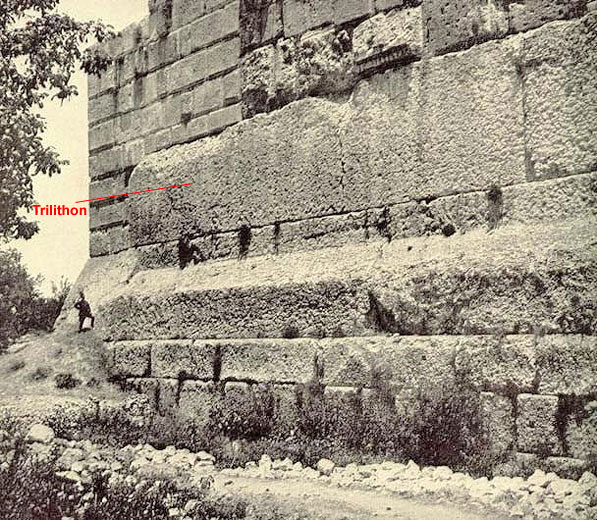
Another little known site is that of Baalbek in Lebanon. As a result of war and terrorism, Baalbek has been a “no go” area for more than twenty years. However, in May 1995, I finally managed to visit the Temple of Jupiter at Baalbek, and I am delighted to be able to share my first-hand impressions of the amazing 800-ton stones which have been miraculously transported and positioned in one of its foundation walls. The difficulties of performing these manoeuvres, even with twentieth century technology, are most enlightening ! Some of the sites not covered in this chapter are dealt with elsewhere. The pyramids of Giza. for instance, warrant a whole chapter in their own right, whilst the ancient astronomical observatory of Stonehenge will be covered in another blog some time latter. A full discussion of the astronomical aspects of Tiwanaku and Pvlachu Picchu is also held over until another blog.
One of the most frustrating areas of ancient technology is that of construction methodology. Almost every engineer has a theory on how his ancient precursors might have carved and erected hugs precision-cut stones, but few such engineers have been brave enough to roll their sleeves up and put their theories to the test. On the few occasions where the experts had dared to venture forth into the field, the results have been dismal. For example, one of the most prominent Egyptologists, Mark Lehner, recently led a team which attempted to erect an Egyptian obelisk using ancient tools and materials. The team had great difficulty explaining how the obelisk was transported up the Nile, since loading it onto a boat seemed to be physically impossible. The same team then had a dreadful struggle to erect an obelisk which was only one tenth the size and weight of the genuine article.
Mark Lehner belongs to a group of experts who believe that the ancient stonemasons worked granite (one of the hardest types of natural stone) by constantly pounding it with other, smaller stones. These experts typically demonstrate how the pounding technique can, after a few hours of effort, produce small indentations in the granite. They then claim this as proof that the pounding method does actually work. Unfortunately, not one of these experts has ever carried such a job through to completion, in order to show us how the stonemasons achieved perfect edges. especially the “inner edges’ of holes which are excavated into the face of the stone. In this chapter, we will see several amazing examples of such stonework. which could not possibly have been produced by the simple stone or copper tools which the ancient people supposedly used. It is not my intention to speculate on exactly what kind of advanced technology was used to cut these stones, nor to answer the question of how they were moved over -impossible” distances and gradients. We map never know. The question which I personally find more pertinent, and equally fascinating, is “why did they do it?”. It is at this point that conventional scientists and historians attempt to distract us from their lack of understanding by vaguely referring to primitive religious beliefs. Some of the most curious anomalies in the world are thus conveniently labelled as temples, altars and ritual baths, when in fact their original purpose and function are totally obscure.
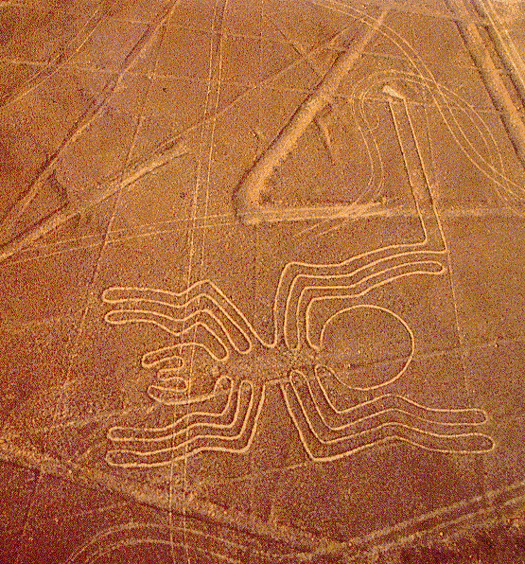
Unless we can understand the significance of an object, the question of “why was it made’!” will get us nowhere. For instance, asking why someone built a Stonehenge temple is a very different question from asking why someone built a Stonehenge Astronomical observatory. It is therefore essential for us to cast off the religious interpretations and examine ancient objects with an open mind. Nevertheless, the significance of some objects is sufficiently clear to frame the relevant questions. Among the questions which I will be asking are: why were 800-ton stones used in a wall at Baalbek when smaller stones would have been quite adequate: why were sophisticated waterworks so important to the original designers of Tiwanaku and Chavin? And why were the figures at Nazca designed only for viewing from the air?
Inevitably, I cannot avoid dropping a few immediate hints towards my answers to the above questions. However, readers must appreciate that a complete solution requires a fundamentally different frame of reference, which will be
gradually introduced in the chapters which follow. In due course, and at the appropriate time, I will revisit nearly all of the sites in this chapter, to confirm their chronologies and to offer my explanations of their functions or meaning. In the meantime, I invite you to share my preliminary thoughts on our mysterious past.
Text excerpt from "The gods of the new millennium".


Another little known site is that of Baalbek in Lebanon. As a result of war and terrorism, Baalbek has been a “no go” area for more than twenty years. However, in May 1995, I finally managed to visit the Temple of Jupiter at Baalbek, and I am delighted to be able to share my first-hand impressions of the amazing 800-ton stones which have been miraculously transported and positioned in one of its foundation walls. The difficulties of performing these manoeuvres, even with twentieth century technology, are most enlightening ! Some of the sites not covered in this chapter are dealt with elsewhere. The pyramids of Giza. for instance, warrant a whole chapter in their own right, whilst the ancient astronomical observatory of Stonehenge will be covered in another blog some time latter. A full discussion of the astronomical aspects of Tiwanaku and Pvlachu Picchu is also held over until another blog.


One of the most frustrating areas of ancient technology is that of construction methodology. Almost every engineer has a theory on how his ancient precursors might have carved and erected hugs precision-cut stones, but few such engineers have been brave enough to roll their sleeves up and put their theories to the test. On the few occasions where the experts had dared to venture forth into the field, the results have been dismal. For example, one of the most prominent Egyptologists, Mark Lehner, recently led a team which attempted to erect an Egyptian obelisk using ancient tools and materials. The team had great difficulty explaining how the obelisk was transported up the Nile, since loading it onto a boat seemed to be physically impossible. The same team then had a dreadful struggle to erect an obelisk which was only one tenth the size and weight of the genuine article.
Mark Lehner belongs to a group of experts who believe that the ancient stonemasons worked granite (one of the hardest types of natural stone) by constantly pounding it with other, smaller stones. These experts typically demonstrate how the pounding technique can, after a few hours of effort, produce small indentations in the granite. They then claim this as proof that the pounding method does actually work. Unfortunately, not one of these experts has ever carried such a job through to completion, in order to show us how the stonemasons achieved perfect edges. especially the “inner edges’ of holes which are excavated into the face of the stone. In this chapter, we will see several amazing examples of such stonework. which could not possibly have been produced by the simple stone or copper tools which the ancient people supposedly used. It is not my intention to speculate on exactly what kind of advanced technology was used to cut these stones, nor to answer the question of how they were moved over -impossible” distances and gradients. We map never know. The question which I personally find more pertinent, and equally fascinating, is “why did they do it?”. It is at this point that conventional scientists and historians attempt to distract us from their lack of understanding by vaguely referring to primitive religious beliefs. Some of the most curious anomalies in the world are thus conveniently labelled as temples, altars and ritual baths, when in fact their original purpose and function are totally obscure.
Unless we can understand the significance of an object, the question of “why was it made’!” will get us nowhere. For instance, asking why someone built a Stonehenge temple is a very different question from asking why someone built a Stonehenge Astronomical observatory. It is therefore essential for us to cast off the religious interpretations and examine ancient objects with an open mind. Nevertheless, the significance of some objects is sufficiently clear to frame the relevant questions. Among the questions which I will be asking are: why were 800-ton stones used in a wall at Baalbek when smaller stones would have been quite adequate: why were sophisticated waterworks so important to the original designers of Tiwanaku and Chavin? And why were the figures at Nazca designed only for viewing from the air?
Inevitably, I cannot avoid dropping a few immediate hints towards my answers to the above questions. However, readers must appreciate that a complete solution requires a fundamentally different frame of reference, which will be
gradually introduced in the chapters which follow. In due course, and at the appropriate time, I will revisit nearly all of the sites in this chapter, to confirm their chronologies and to offer my explanations of their functions or meaning. In the meantime, I invite you to share my preliminary thoughts on our mysterious past.
Text excerpt from "The gods of the new millennium".
Antarctica free of ice
On 6th July 1960 Lt Colonel Harold Ohlmeyer, a United States Airforce Commander, sent a reply to a letter from one Professor Charles Hapgood who had requested his opinion on a feature found on a map of 1513 AD called the Piri Reis Map. Lt Colonel Ohlmeyer's reply was a bombshell. The map, showing the coastline of the east coast of the Americas and the west coast of Africa, the Colonel remarked, also seemed to show the coastline of Queen Maud Land in Antarctica free of ice - a condition it had not been in for some 9000 years!
In fact, it is only in recent times that modern man has been able to map this coastline using sub-surface surveying techniques that can penetrate the ice sheet that lies on top of it.
Ohlmeyer had no idea how a map existing in the 16th century could have got hold of such knowledge.
This was one of the many mysteries that lead Graham to begin his epic journey into man's past that is Fingerprints of the Gods - and it is a mystery whose solution is mindblowing.
Travelling first to South and Meso-America, Graham finds evidence of myths of a white-skinned 'god' named Quetzalcoatl or 'Viracocha' who came from a drowned land bringing knowledge of farming and culture after a great flood. Tied in with these myths Graham begins to crack an ancient code imprinted in these ancient tales that refer to the 'great mill' of the heavens.
It is an astronomical code that deals with the position of the stars over vast periods of time - a code that reveals the ancients knew far, far more than they are generally credited with. Traces of the same code appear in Egyptian myth, and it is to this desert land that Graham and Santha travel, finding there haunting parallels in architecture and ritual to the New World sites they have just left behind.
Moreover, the whole layout of the Giza plateau seems to point to a date many thousands of years earlier than the date of its supposed construction - a date revealed in the astronomical alignments of the Pyramids, the 'mansions of a million years', home of the god Osiris, the bringer of agriculture to the Egyptians, like Quetzalcoatl, after a flood.
Could the Piri Reis maps be evidence for a previously unknown complex maritime civilisation, capable of mapping the globe? A global culture, cataclysmically destroyed at the end of the ice age, remnants of which survived the devastation to pass on their knowledge to the shaken world?
Were the figures of Osiris and Quetzalcoatl survivors of this lost race - passing down not only advanced geographical knowledge, but a secret astronomical code veiled in myth that pointed to the devastation in the past, and warned of that which is to come?
From the mysterious sites of Tiahuanaco and Teotihuacan, to the enduring enigmatic Sphinx and pyramids of Egypt, the grandiose Nazca lines of Peru to the stark primal beauty of the Osireion at Abydos, this is a journey both around the globe and into the heart of the true prehistoric origins of man. Part adventure, part detective story, this book will force you to revaluate your beliefs of the past.
In fact, it is only in recent times that modern man has been able to map this coastline using sub-surface surveying techniques that can penetrate the ice sheet that lies on top of it.
Ohlmeyer had no idea how a map existing in the 16th century could have got hold of such knowledge.
This was one of the many mysteries that lead Graham to begin his epic journey into man's past that is Fingerprints of the Gods - and it is a mystery whose solution is mindblowing.
Travelling first to South and Meso-America, Graham finds evidence of myths of a white-skinned 'god' named Quetzalcoatl or 'Viracocha' who came from a drowned land bringing knowledge of farming and culture after a great flood. Tied in with these myths Graham begins to crack an ancient code imprinted in these ancient tales that refer to the 'great mill' of the heavens.
It is an astronomical code that deals with the position of the stars over vast periods of time - a code that reveals the ancients knew far, far more than they are generally credited with. Traces of the same code appear in Egyptian myth, and it is to this desert land that Graham and Santha travel, finding there haunting parallels in architecture and ritual to the New World sites they have just left behind.
Moreover, the whole layout of the Giza plateau seems to point to a date many thousands of years earlier than the date of its supposed construction - a date revealed in the astronomical alignments of the Pyramids, the 'mansions of a million years', home of the god Osiris, the bringer of agriculture to the Egyptians, like Quetzalcoatl, after a flood.
Could the Piri Reis maps be evidence for a previously unknown complex maritime civilisation, capable of mapping the globe? A global culture, cataclysmically destroyed at the end of the ice age, remnants of which survived the devastation to pass on their knowledge to the shaken world?
Were the figures of Osiris and Quetzalcoatl survivors of this lost race - passing down not only advanced geographical knowledge, but a secret astronomical code veiled in myth that pointed to the devastation in the past, and warned of that which is to come?
From the mysterious sites of Tiahuanaco and Teotihuacan, to the enduring enigmatic Sphinx and pyramids of Egypt, the grandiose Nazca lines of Peru to the stark primal beauty of the Osireion at Abydos, this is a journey both around the globe and into the heart of the true prehistoric origins of man. Part adventure, part detective story, this book will force you to revaluate your beliefs of the past.
{Fingerprints of the Gods}
Downloads E-Book @ http://www.scribd.com/doc/19888739/Fingerprints-of-the-Gods-Graham-Hancock
or Order it at Amazone.
Subscribe to:
Posts (Atom)